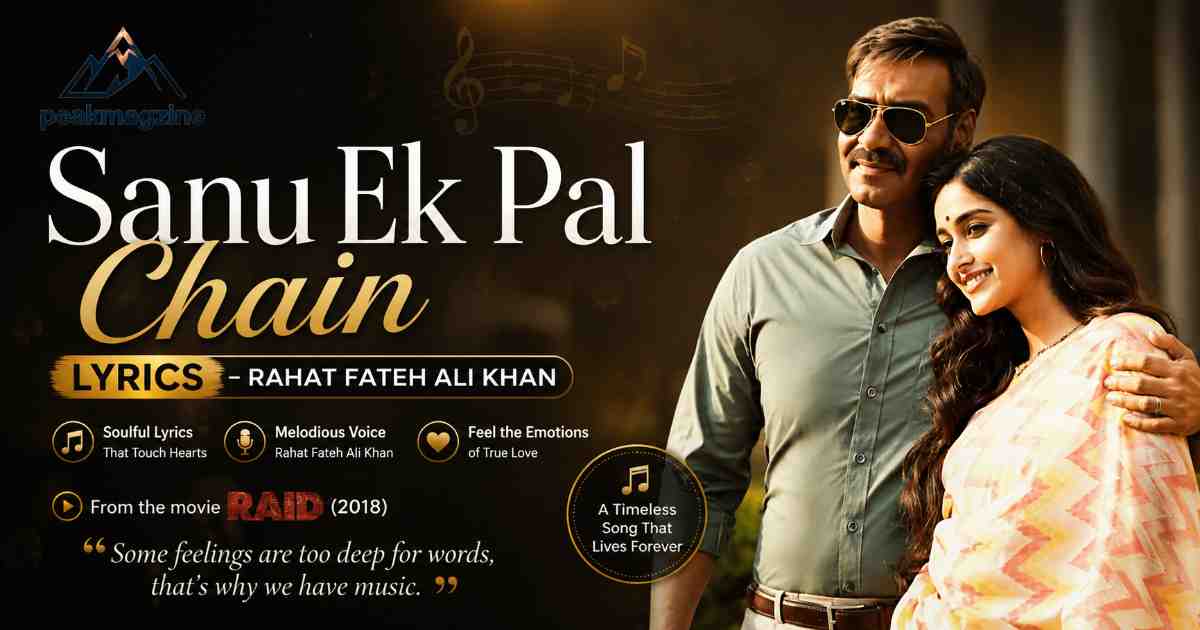
Sanu Ek Pal Chain Lyrics – Rahat Fateh Ali Khan Masterpiece
Introduction
Some songs do not just play in your ears. They settle quietly into your heart and stay there for years. “Sanu Ek Pal Chain Na Aave” is exactly that kind of song. Whether you first heard it as a devotional qawwali from the legendary Nusrat Fateh Ali Khan or discovered it through the 2018 Bollywood film Raid, this track carries an emotional weight that is truly hard to put into words.
Sung by the enormously gifted Rahat Fateh Ali Khan, this recreated version brought a timeless classic to an entirely new generation of music lovers. With its soulful melody, deeply moving lyrics, and Rahat’s signature vocal style, “Sanu Ek Pal Chain” quickly became one of the most searched and most loved songs from any Bollywood soundtrack released that year.
In this article, we will walk you through everything there is to know about this beloved song. From the singer’s rich background and musical heritage to the full lyrics, their English translation, and answers to frequently asked questions, this is your complete guide to “Sanu Ek Pal Chain Na Aave.”
Singer About Details
To truly understand “Sanu Ek Pal Chain,” you need to understand the man whose voice gave it new life. Rahat Fateh Ali Khan is not just a singer. He is a living bridge between classical Sufi devotional music and the modern world of Bollywood and global pop.
Early Life and Musical Roots
Rahat Fateh Ali Khan was born on December 9, 1974, in Faisalabad (formerly Lyallpur), Punjab, Pakistan. He grew up in a family where music was not a hobby but a way of life. His father, Farrukh Fateh Ali Khan, was a respected harmonium player who performed in the legendary qawwali ensemble led by Ustad Nusrat Fateh Ali Khan. His grandfather, Fateh Ali Khan, was one of the most celebrated qawwali singers of his era, winning the Pride of Performance award in Pakistan in 1960.
Rahat showed musical talent from a remarkably young age. He began learning music at the age of just three, singing alongside his father and uncle. By age six, he began formalized training under his uncle Nusrat. He gave his first public stage performance at the age of ten when Nusrat Fateh Ali Khan toured the United Kingdom in 1985. By age fifteen, Rahat had officially joined his uncle’s celebrated performing group.
Read More: BLACK RIDE Lyrics – Dhanda Nyoliwala, Hammy Muzic (Full Song)
Key Details About Rahat Fateh Ali Khan
| Detail | Information |
| Full Name | Rahat Fateh Ali Khan |
| Date of Birth | December 9, 1974 |
| Birthplace | Faisalabad, Punjab, Pakistan |
| Father | Farrukh Fateh Ali Khan |
| Uncle | Ustad Nusrat Fateh Ali Khan |
| Grandfather | Fateh Ali Khan |
| Music Genres | Qawwali, Ghazal, Sufi, Filmi, Classical |
| Instruments | Vocals, Harmonium |
| Active Since | 1997 |
| Music Labels | T-Series, Sony Music, Universal Music, YRF Music, Coke Studio |
| Nationality | Pakistani |
| Zodiac Sign | Sagittarius |
Career and Legacy
After the passing of Nusrat Fateh Ali Khan in August 1997, Rahat assumed leadership of his uncle’s qawwali group just six weeks later. In a deeply meaningful tribute, he adopted his uncle’s first name, becoming “Rahat Nusrat Fateh Ali Khan,” an acknowledgment formally recognized by the music world as him stepping into the role of carrying forward the qawwal tradition.
His Bollywood journey began in 2003 when filmmaker Pooja Bhatt, during a visit to Pakistan, heard his song “Mann Ki Lagan” and decided to include it in the film Paap. From that moment, Rahat’s voice became a fixture in Hindi cinema. Some of his most celebrated Bollywood contributions include:
- “O Re Piya” from Aaja Nachle (2007)
- “Tum Jo Aaye” from Once Upon a Time in Mumbai (2010)
- “Bol Na Halke Halke” from Jhoom Barabar Jhoom (2007)
- “Jag Ghoomeya” from Sultan (2016)
- “Tere Bin” from Simmba (2018)
- “Sanu Ek Pal Chain” from Raid (2018)
Beyond Bollywood, Rahat has also performed internationally, including a notable collaboration with rock legend Eddie Vedder at the Dead Man Walking concert organized by director Tim Robbins. He has performed to sold-out crowds worldwide, from Dubai to the United Kingdom, Canada, and the United States, consistently proving that Sufi music transcends all cultural borders.
His voice is described by critics and fans alike as carrying a deep spiritual energy that elevates any song it touches. He seamlessly blends the ancient classical Qawwali tradition with contemporary musical arrangements, making devotional and romantic Sufi music accessible to listeners everywhere.
Awards and Recognition
Rahat Fateh Ali Khan is one of the most decorated singers in both Pakistan and India. Among the many honors he has received, the Mirchi Music Award for “Re-created Song of the Year” in 2018, awarded specifically for “Sanu Ek Pal Chain,” stands out as a fitting recognition for this particular song. He is widely regarded as one of the highest-paid and most popular singers in Pakistan and a beloved figure across South Asia and beyond.
Sanu Ek Pal Chain Song Lyrics
Sanu ek pal chain na aave
Sanu ek pal chain na aave
Sajna tere bina
Sajna tere bina
Dil jaane kyun ghabraave
Dil jaane kyun ghabraave
Sajna tere bina
Sajna tere bina
Sanu ik pal chain na aave
Sanu ik pal chain na aave
Sajna tere bina
Sajna tere bina
Ye din hain pyaare heeriye
Jo saath mein humne jee liye
Jaana nahin munh mod ke
Akhiyon mein paani chhod ke
Ye paani aag lagaave
Ye paani aag lagaave
Sajna tere bina
Sajna tere bina
Sanu ik pal chain na aave
Sanu ik pal chain na aave
Sajna tere bina
Sajna tere bina
Tera khayal har ghadi
Hai aadatein mujhe teri
Ik din jo tujhse naa milun
Paagal ke jaisa main phirun
Koi rut na mujhko bhaave
Koi rut na mujhko bhaave
Sajna tere bina
Sajna tere bina
Sanu ek pal chain na aave
Sanu ek pal chain na aave
Sajna tere bina
Sajna tere bina
Sajna re… tere bina…
Song English Translation
The lyrics of “Sanu Ek Pal Chain Na Aave” paint a vivid, aching picture of longing and separation. Written by the accomplished lyricist Manoj Muntashir for the Bollywood film Raid (2018), the words beautifully blend Hindi and Punjabi, carrying the emotional spirit of the original qawwali while adding a fresh Bollywood sensibility.
Below is a verse-by-verse English translation that captures the meaning and feeling of the song:
Mukhda (Refrain) – Translation
Original: Sanu ek pal chain na aave / Sajna tere bina Translation: Not a single moment of peace comes to me / O my beloved, without you
Original: Dil jaane kyun ghabraave / Sajna tere bina Translation: The heart trembles, and I do not know why / O my beloved, without you
This opening verse sets the entire emotional tone of the song. The singer is restless, unable to find calm or comfort in the absence of their beloved. There is no peace, no stillness. Every moment is filled with an anxious, aching awareness of that absence.
First Verse – Translation
Original: Ye din hain pyaare heeriye / Jo saath mein humne jee liye Translation: These are the precious days, my love / That we have lived together side by side
Original: Jaana nahin munh mod ke / Akhiyon mein paani chhod ke Translation: I do not want to leave by turning my face away / Leaving tears behind in your eyes
Original: Ye paani aag lagaave / Sajna tere bina Translation: These tears feel like fire upon me / O my beloved, without you
This verse explores the bittersweet beauty of shared memories. The couple has lived beautiful days together, and the very thought of separation is unbearable. Even the tears shed in parting feel like burning fire, so deep is the love and so sharp is the pain.
Second Verse – Translation
Original: Tera khayal har ghadi / Hai aadatein mujhe teri Translation: Your thought fills every moment of my day / I have grown so used to you, so deeply habitual
Original: Ik din jo tujhse naa milun / Paagal ke jaisa main phirun Translation: Even one day without meeting you / And I wander around like a person who has lost their mind
Original: Koi rut na mujhko bhaave / Sajna tere bina Translation: No season, no time, no moment feels right or pleasant / O my beloved, without you
This second verse takes the emotion even deeper. The beloved has become such an essential part of everyday life that even a single day apart causes a kind of madness. No season or circumstance brings any joy when the beloved is not present.
Overall Meaning and Theme
The song is, at its heart, about the kind of love that becomes inseparable from one’s very existence. It is not just romantic love in the casual sense. It is a deeply spiritual longing, the kind that Sufi poetry has always explored beautifully. The beloved’s absence does not just cause sadness. It creates complete restlessness of the soul.
This is why the song resonates so deeply with listeners across generations. Whether they are separated from a lover by distance or by time, or whether they feel the deeper spiritual longing that Sufi music traditionally speaks to, “Sanu Ek Pal Chain Na Aave” touches something profoundly human in all of us.
Song Details at a Glance
| Detail | Information |
| Song Title | Sanu Ek Pal Chain Na Aave |
| Film | Raid (2018) |
| Singer | Rahat Fateh Ali Khan |
| Music Composer | Tanishk Bagchi |
| Lyricist | Manoj Muntashir |
| Music Label | T-Series |
| Original Qawwali | Sanu Ik Pal Chain Na Aave by Nusrat Fateh Ali Khan (1993) |
| Film Director | Raj Kumar Gupta |
| Film Cast | Ajay Devgn, Ileana D’Cruz, Saurabh Shukla |
| Release Year | 2018 |
| Language | Hindi / Punjabi |
| Genre | Sufi, Filmi, Romantic Ballad |
| Award Won | Mirchi Music Award, Re-created Song of the Year (2018) |
The Connection to Nusrat Fateh Ali Khan’s Original
It is important to acknowledge that the roots of this song go far deeper than the 2018 film. The original qawwali, “Sanu Ik Pal Chain Na Aave,” was composed and performed by the incomparable Ustad Nusrat Fateh Ali Khan. Released as part of his expansive catalog, the original version runs for approximately eight to nine minutes and carries the full rhythmic intensity and spiritual elevation of traditional qawwali.
Music composer Tanishk Bagchi, who is widely known in Bollywood for his skill with recreations and remixes, reworked the original melody for contemporary audiences while preserving its emotional and sonic essence. Lyricist Manoj Muntashir added fresh Hindi verses that kept the spirit of the original intact while making the song narratively suitable for the film’s romantic subplot.
The result was something remarkable: a song that introduced Nusrat Fateh Ali Khan’s genius to younger listeners who may not have been familiar with classical qawwali, while also giving longtime fans of the original a beautifully rendered new version performed by Rahat, the man who carries that musical legacy forward better than anyone else alive.
The song won the Mirchi Music Award for Re-created Song of the Year in 2018, a recognition that speaks to just how successfully this creative team honored the original while making it fresh and relevant.
Conclusion
“Sanu Ek Pal Chain Na Aave” is far more than a Bollywood film song. It is a piece of musical history, a bridge between the timeless Sufi tradition of Ustad Nusrat Fateh Ali Khan and the present-day world of Hindi cinema, carried across that bridge by the extraordinary voice of Rahat Fateh Ali Khan.
The song’s words speak about love, longing, and the kind of restlessness that comes when someone essential is absent. Its melody carries the devotional intensity of qawwali. And its singer brings to it decades of musical training, a deep spiritual connection to the material, and a vocal ability that is genuinely rare in any generation.
Whether you first heard this song in the theatre during Raid, on a streaming platform, or at one of Rahat’s live concerts, it likely left a mark on you. That is the power of great music rooted in a great tradition. It does not merely entertain. It reaches into something real within us and holds on.
If you have not yet listened to both the original Nusrat Fateh Ali Khan version and Rahat’s 2018 recreation, take the time to do so. You will hear two generations of one of the greatest musical families in South Asian history, pouring their hearts into the same beautiful sentiment: that without the beloved, not a single moment of peace is possible.
FAQs
H3: Who sang Sanu Ek Pal Chain in the film Raid?
The song was sung by Rahat Fateh Ali Khan for the 2018 Bollywood film Raid, featuring Ajay Devgn and Ileana D’Cruz.
H3: Who wrote the lyrics of Sanu Ek Pal Chain?
The lyrics were written by the celebrated lyricist Manoj Muntashir, who is also known for writing songs like “Teri Mitti” and “Galliyan.”
H3: Who composed the music for Sanu Ek Pal Chain from Raid?
The music was composed by Tanishk Bagchi, who recreated and modernized the original qawwali melody originally composed by Nusrat Fateh Ali Khan.
H3: What is the original version of Sanu Ek Pal Chain?
The song is a recreation of “Sanu Ik Pal Chain Na Aave,” a devotional qawwali originally performed by Ustad Nusrat Fateh Ali Khan and released in 1993.
H3: What is the meaning of Sanu Ek Pal Chain Na Aave?
It translates from Punjabi and Hindi as “Not a single moment of peace comes to me, O beloved, without you.” It expresses deep longing and restlessness caused by separation from a loved one.
H3: Is Rahat Fateh Ali Khan related to Nusrat Fateh Ali Khan?
Yes, Rahat Fateh Ali Khan is the nephew of Ustad Nusrat Fateh Ali Khan. He also trained directly under his uncle and took over leadership of the qawwali group after Nusrat’s passing in 1997.
H3: Which award did Sanu Ek Pal Chain win?
The song won the Mirchi Music Award for Re-created Song of the Year in 2018, recognizing the creative team of Rahat Fateh Ali Khan, Manoj Muntashir, and Tanishk Bagchi.
H3: Under which music label was Sanu Ek Pal Chain released?
The song was released under T-Series, one of India’s largest and most prominent music labels.
H3: What film did Sanu Ek Pal Chain appear in?
The song appeared in the 2018 Bollywood film Raid, directed by Raj Kumar Gupta and produced by T-Series Films and Panorama Studios.
H3: What language is Sanu Ek Pal Chain sung in?
The song is sung in a mix of Hindi and Punjabi, which is characteristic of both Bollywood film music and the traditional qawwali style from which it originates.

Awais is the founder of PeakMagzine.com and an experienced digital content creator with over 4 years of SEO expertise. He specializes in writing optimized, engaging articles, helping websites rank higher on search engines and reach a wider global audience effectively.